
|
Dear Concierge Members:
I trust this email finds you in good health and spirits ahead of the Thanksgiving holiday. As your dedicated healthcare provider, I wanted to take a moment to express my sincerest gratitude for the privilege of being a part of your wellness journey. Throughout our interactions, whether for routine check-ups or times when you've sought my guidance, I have been continually impressed by your commitment to your health and honored by the trust you have placed in me. Your dedication to making positive changes has not only reflected on your own well-being, but has also inspired me in my profession. It's patients like you who remind me why I chose to be a physician—to make a positive impact on lives, to provide care, and to be a source of support. Your openness in sharing your concerns and your active participation in healthcare decisions have truly made our doctor/patient relationship a remarkable one. Please remember that your health and well-being remain my top priority. If you ever have questions, need guidance, or simply want to discuss an aspect of your health, please don't hesitate to reach out. I am here to provide you with the best service possible. As we continue this journey together, I am excited to witness your progress and support you in achieving your health goals. Thank you once again for allowing me to be a part of your healthcare team. Wishing you a Happy Thanksgiving. Warm regards, Dr. David Leonard
0 Comments
 A Scary Look at Data Misrepresentation in Nutritional Science
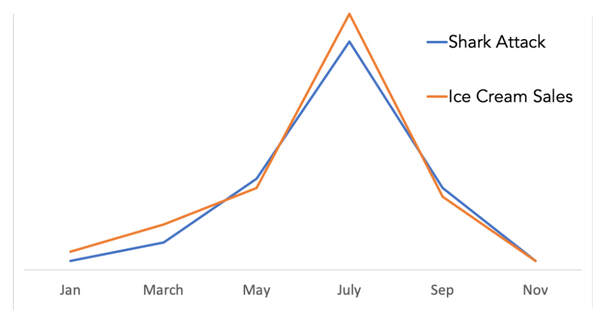
As consumers of information, we are barraged daily with conflicting information, nowhere is this more evident than in nutrition research where the information seems to change from week to week. Why is this the case? We can start with how people eat: are the people in the fake headline above just eating ice cream? Likely they are eating the usual ice cream companions like cones, sprinkles, whipped cream and hot fudge. People follow patterns of eating behavior. It is virtually impossible to take a reductionist view of what people eat and limit it to a single food or nutrient. Then, we can look at how the data is collected. Most often, nutrition research asks people to recall what they ate over a given period of time in the past. Do you recall how much ice cream you ate last summer? Last month? Last week? Was it soft serve or hard? What flavor was it? Was it dairy or dairy-free? Did you add toppings? Was it served in a cup or a cone? What type of cone? …Just how accurate do you think the information collected is? Next, we can examine the participants in the study. How many participants are needed before one can make the observation in our fake headline? 3? 30? 300? What were the demographics of the participants? Was it a diverse group of people (age, ethnicity, socioeconomic status, geographical location, etc.)? If all the participants in our fake headline were 80-year-old Caucasian females living in the Bronx, then it would be nonsensical to the extrapolate trends from this data to anyone other than 80-year-old Caucasian females living in the Bronx. Then, ask yourself, is observation causation? The answer is no. That is a fundamental issue with study design. Much nutrition research is observational. We observe “associations” between variables, but we cannot control unforeseen variables. Let’s take our fake headline: What if the participants in the study ate their ice cream on a sugar cone? How do we know the shark bite wasn't due to the cone and not the ice cream at all? By not measuring the sugar cone as a variable we have made a false association between ice cream and shark attacks. In addition, it is rare in nutrition research to see a “gold standard” randomized control trial (RCT) in nutrition whereby people are randomly assigned to an intervention and a control group. In our fake headline, one group would eat ice cream, one group would not (the control group) but they would both go swimming at the beach. Then we would be able to draw comparisons between the two groups about a shark attack. Sometimes the research comes up flat and nothing of interest is found. These negative results are important! They add to the body of knowledge on a subject. However, negative results aren’t highly sought after and are rarely published. This is referred to as publication bias. What if 10 previous studies found no association between eating ice cream and shark attacks, but because this was a positive result it was the only one published? The body of knowledge suffers as does the information disseminated to the public. It is sad but true, that much research is funded by industries. The nut industry funds much of the research on nuts. The cacao industry funds much of the research on chocolate, and so on. Again, positive findings are more likely to be published, negative findings are repressed. Unfortunately, these positive findings are then used by the government to make nutrition guidelines and recommendations. Researchers are human, they have egos and pride. The careers of scientists are built on their hypotheses, and, like industries, they have a vested interest in positive findings. Disappointingly, research is replete with insidious behavior meant to protect and promote careers. Finally, there is the media; their job is to promote ratings. They are not obligated to properly vet the research (study design, participants, funding, etc.). Additionally, the media fails to properly explain the implication behind the headline (i.e. what does this mean to you?) Where does this leave us, the consumers of information who want to make smart nutrition choices? Do we throw the baby out with the bathwater? Throw our hands up and eat Oreos for breakfast? Pringles for lunch? Not exactly. However, we do have a responsibility to take a look behind the headlines before making dietary decisions that impact our health. Sometimes that may mean getting the original research and using the above to decide if the study is valid for us. Feel free to email Concierge Choice Physicians ([email protected]) with your questions or even send a headline or study to us, and we will be happy to answer your questions. After a few years of a very uncertain travel market and amid subsequent changes to the industry, many of us are resuming regular travel and taking much needed vacations. But before you hit the roads and skies for travel, be sure to prepare yourself and pack your bags for medical scenarios.
Importantly, make sure to refill all your prescriptions ahead of your trip at least one week in advance of your departure and always bring at least a few extra days’ worth of medication with you. With the state of the travel industry, there is a high probability of your return not going quite as planned. You should always pack your medications in your carry-on—not in your checked suitcase—just in case your luggage is lost. The Pack Smart Guide from the CDC offers a checklist to help you prepare for a healthy trip, including prescriptions, medical supplies, over-the-counter medicines, supplies to prevent illness or injury, first-aid kits and important documents. Many items in this list would be especially helpful if you are heading off the grid or traveling to an exotic location where medical supplies are not conveniently available at a local drugstore. Also, keep in mind, I do not offer travel vaccines and would need to refer you to the health department, so, please plan ahead. The CDC offers a complete list of destinations with travel health notices, recommended vaccines and precautions to consider for your specific destination. Finally, make sure to enter my concierge contact details into your phone—including my cell number and email—and remember to pack your membership card so that you can reach me with any medical concerns during your trip. I can potentially offer a telemedicine visit, call in a prescription or, based on your destination, help to arrange a visit with a local Concierge Choice Physicians provider if needed. As always, feel free to reach me with any questions. Safe travels! Three years ago, we were met with a global health crisis that resulted in many of us putting our other health concerns on pause, and I want to be sure you have all shifted your focus back to your overall health and wellness.
Have you kept up with your yearly physical? Is it time to do a full review of your medicine and treatment regimens? Have you gained or lost significant weight? How are your stress levels, sleep patterns, fitness programs and anxiety? Your annual comprehensive examination could be the foundation of your good health. Diseases and conditions such as hypertension, cancer, and anemia can be asymptomatic, for example, but a thorough history, physical examination, laboratory testing, and an in-depth discussion may prove revealing and lifesaving. We can also take advantage of this time together to create a plan to help you meet your wellness goals. Let’s partner toward your best health. Please contact our office to schedule your annual exam. And as always, I am available should you have any concerns or questions. |
AuthorDavid D. Leonard, MD, FAAFP is a primary care specialist with Family Physicians of Old Town Fairfax Archives
November 2023
Categories |
 RSS Feed

©2019 Family Physicians of Old Town Fairfax. All rights reserved.